
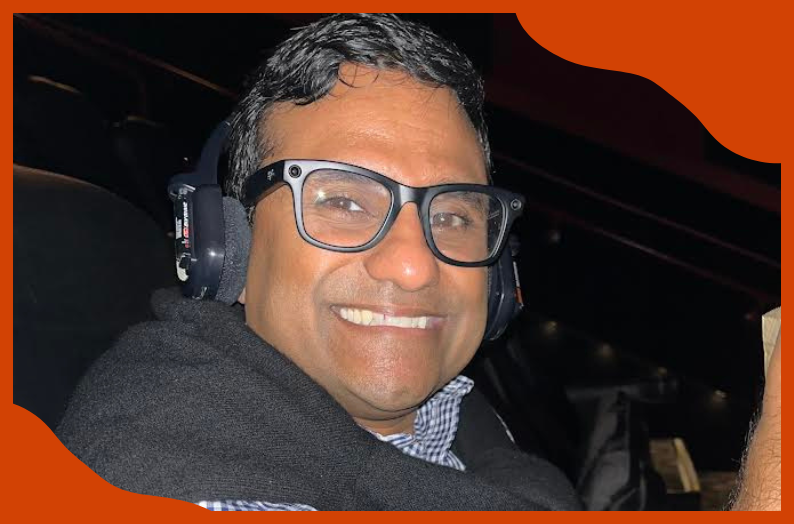
I grew up loving TV. From TGIF, to MTV – I loved it all! However, as a kid growing up with Indian parents, I wasn’t allowed to watch much television, but rather I was expected to spend any free time I had reading books or studying. But when someone tells you, you can’t have something, you want it even more, and that was television for me! So, whenever my parents were out of the house, it was almost a given that I would be sitting on the ground right in front of that pixelated screen!
And over the years since I was a kid, my relationship with television has changed. When I moved to Bangalore, my DVDs of the show Lost kept me company before I had friends to hang out with on a Friday night, and when I moved to New York City, I watched the movies Fletch or Caddy Shack every night to drown out the noise of the bar I lived above. And even when I moved out to Cameroon, I’d keep the one English Channel that played American shows on pretty much any time I was in my apartment, to help me from being homesick.
However, as my sight started to deteriorate, I found myself spending less and less time with the television on, and if it was, I would be watching Friends or Seinfeld, or another 90’s show that I had seen a thousand times before. The reason was that even though I wasn’t able to see the screen, I could picture what was on in my mind, because I had memorized them. I didn’t have to see the purple walls of Monica and Rachel’s apartment, to know where they were, because it had been imprinted in my mind since I was a kid.
I was totally content with watching the same old shows repeatedly (don’t feel bad for me, because this has served me well when I’ve found myself playing “Friends” trivia at numerous parties!) obviously I wasn’t up to date with the latest shows, because it was often too difficult to follow.
This was the case when I started to date Nicole, and we tried to watch an episode of “Game of Thrones” which was quite popular at the time. That show had so many different characters, that I couldn’t follow the voices, and there was even more going on visually, that it was nearly impossible for Nicole to describe to me to make it enjoyable for anyone. So, if Nicole and I were spending an evening in front of the television, we found ourselves gravitating to standup comedians, where there was only one character for me to follow, and there was very little in terms of descriptions for Nicole to provide. Thank goodness for us that Netflix seems to give every standup comedian out there their very own special these days!
Over the past several years, television has become increasingly accessible to individuals with disabilities, thanks to features like closed captions, subtitles, and audio descriptions.
Closed captions display not only the spoken dialogue but also relevant non-speech audio cues—like music, laughter, or sound effects—as on-screen text. This feature is designed primarily for individuals who are Deaf or Hard of Hearing, allowing them to follow along with both the words and the surrounding audio context of a program.
Subtitles, on the other hand, typically represent only the spoken dialogue and are intended for viewers who can hear but may not understand the language being spoken. Subtitles are often used for translating foreign-language content, and they usually don’t include non-speech sounds or speaker identification.
Interestingly, the use of captions and subtitles has expanded well beyond their original purposes. According to a recent CBS News poll, over half of Americans keep subtitles turned on some (21%) or all (34%) of the time—especially among younger viewers. People cite reasons like improving comprehension, understanding strong accents, or watching content in noisy environments.
Audio descriptions provide a narrated account of key visual elements in a program, such as actions, scene changes, gestures, and on-screen text. This narration is inserted during natural pauses in dialogue, allowing individuals who are blind or visually impaired to understand the visual context of the content.
While closed captions and subtitles are widely recognized and utilized, audio descriptions are less commonly known.
Even though I started to use audio description devices when I went to the movies or to a play, I previously had never used audio descriptions when watching a television show! I think the main reason for this was because whenever I was watching something new on TV, Nicole would describe anything I asked (we were in the comfort of our own home!), and I just got used to not having all the details and filling them in with my mind (which is sometimes even more fun!) However, last year it seemed that in almost every podcast I was listening to, and throughout my newsfeed, the show “White Lotus” was coming up. However, it wasn’t the case for Nicole, and she had no interest in watching it. I don’t know what this says about me or my online presence, but I decided that White Lotus was something I was going to check out!
Going in, I had very little understanding of the show, except that it took place in a super fancy hotel, and that the latest season had a family that was supposed to be from North Carolina. So, I thought I would start there.
As I started to watch the show, I found myself lost at times because people weren’t always talking, and I was going to give up on it. But for some reason, before ending it, I turned on audio descriptions, and at that moment, everything changed!
The audio descriptions described all the nonverbal cues that were going on, from every tip of a glass to the movements happening under the sheets (you must watch it, to believe it!), and it brought the show to life for me! For the first time, I was able to binge a new show (other than Love is Blind!), and I even watched the previous two seasons afterwards!
After binging White Lotus, I tried out audio descriptions on the movie “Ready Player One” and it gave me just enough information to make my mind go wild thinking about what a world in Virtual Reality could look like!
Audio descriptions have opened a whole new world for me, which I’m super excited about! Don’t get it twisted, I don’t see myself going back and binging all of the shows and movies that I’ve missed over the past decade, but knowing that I have the choice to watch or not, is so powerful, and for that I will be forever grateful to the White Lotus for opening my eyes (which now includes a daily protein shake!)
Let me know what television show I should try out next, and if you try out listening to your favorite show with audio descriptions, I want to know how it goes!
0 Comments