
When I was moving back home to North Carolina from Washington, DC, and I didn’t yet have a job lined up, my friend Ed Summers gave me advice that stuck with me — though I didn’t fully understand it at the time.
He told me not to buy a house until I had a job.
On the surface, which sounded practical. No income? Don’t take on a mortgage!
But what he was really talking about was transportation.
As someone who is blind, transportation isn’t just an inconvenience, it’s a constant calculation. I don’t drive, so I rely on Uber, family members, or others to get where I need to go – and that includes work.
The first house I moved into when we came back to North Carolina was seven miles from the office. A quick ride, and a relatively inexpensive Uber.
Later, Nicole and I bought my childhood home, which was still just seven miles from the office, less than 15 minutes away, and an even cheaper Uber!
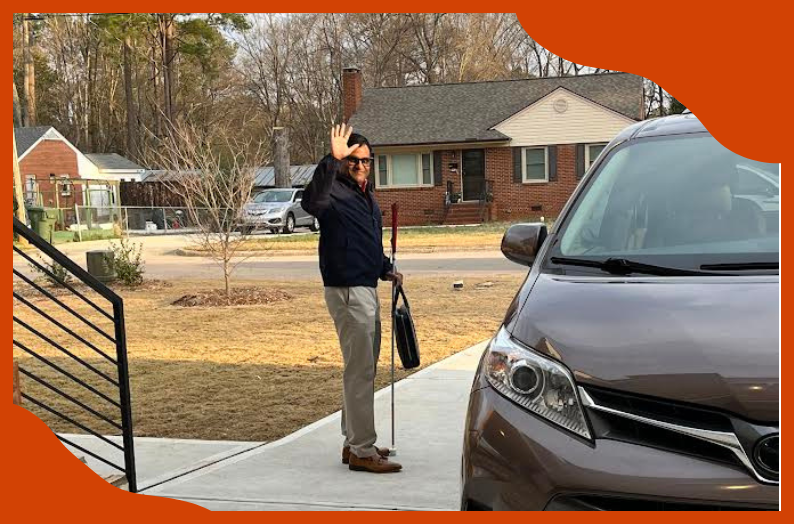
Then last week, we moved again – just a couple miles closer to downtown Cary. It’s in the same general area, and in fact it’s off the same main street as our office!
I assumed it wouldn’t make much difference in terms of my commute time or Uber fare.
Well, it added seven minutes to my commute, but more surprisingly, it nearly doubled the cost of my ride!
Sitting in that Uber, I did the math. Weekly. Monthly. Yearly. And I thought: Thank goodness I don’t go on five days a week, because that could have been an additional $5,000 in expenses!
Then I thought about the many other people with disabilities who don’t have that flexibility of having a hybrid job and need to commute daily. Those people who must live farther out because housing is cheaper, and Who don’t have family nearby.
In that moment, Ed’s advice became crystal clear.
This is what we call the Disability Tax.
So, what Is the Disability Tax?
The Disability Tax isn’t an official fee, and it’s not a line item from the IRS. But rather, it’s the extra cost people with disabilities pay simply to live our lives – costs that many nondisabled people don’t ever have to think about.
The thing about the disability tax is that it shows up quietly, Consistently, and Relentlessly. And transportation is just one example!
As I dug into this, I realized that the numbers tell the financial truth.
We often talk about disability in medical terms – but disability is also an economic experience.
Households with an adult who has a work limiting disability require, on average, 28% more income to maintain the same standard of living as a comparable household without a disability.
However, people with disabilities earn, on average, around $10,000–$15,000 less per year than those without disabilities – But it’s estimated that a person with a disability needs an additional $17,690 per year just to achieve parity in standard of living!
Then a recent study showed that for many people, $1 out of every $5 spent goes directly toward expenses that are related to their disability (Which was eye opening to me!).
However, there are several things that we can do to reduce the disability tax on people:
- Accessible transportation reduces the transportation tax.
- Inclusive hiring reduces the employment tax.
- Digital accessibility reduces the time tax.
- Thoughtful design reduces the economic burden.
I’ve been advocating that accessibility isn’t charity, but what this experience has shown me that it’s actually economic equity. The Disability Tax is not a personal failing, but rather it’s a design flaw in our economy. We have built a world where accessibility is often treated like a luxury feature rather than a human right. The best thing is, we can build it differently, because no one should have to pay extra just to participate in everyday life!
So, as I wrap up, I challenge you to ask yourself – Who is paying the Disability Tax on the systems I influence?
Well, this is a question that I’ll be thinking about with my extra time in my Uber!
0 Comments